
Subtotal: SGD$0.00
Knee Pain Climbing Stairs? What It Means
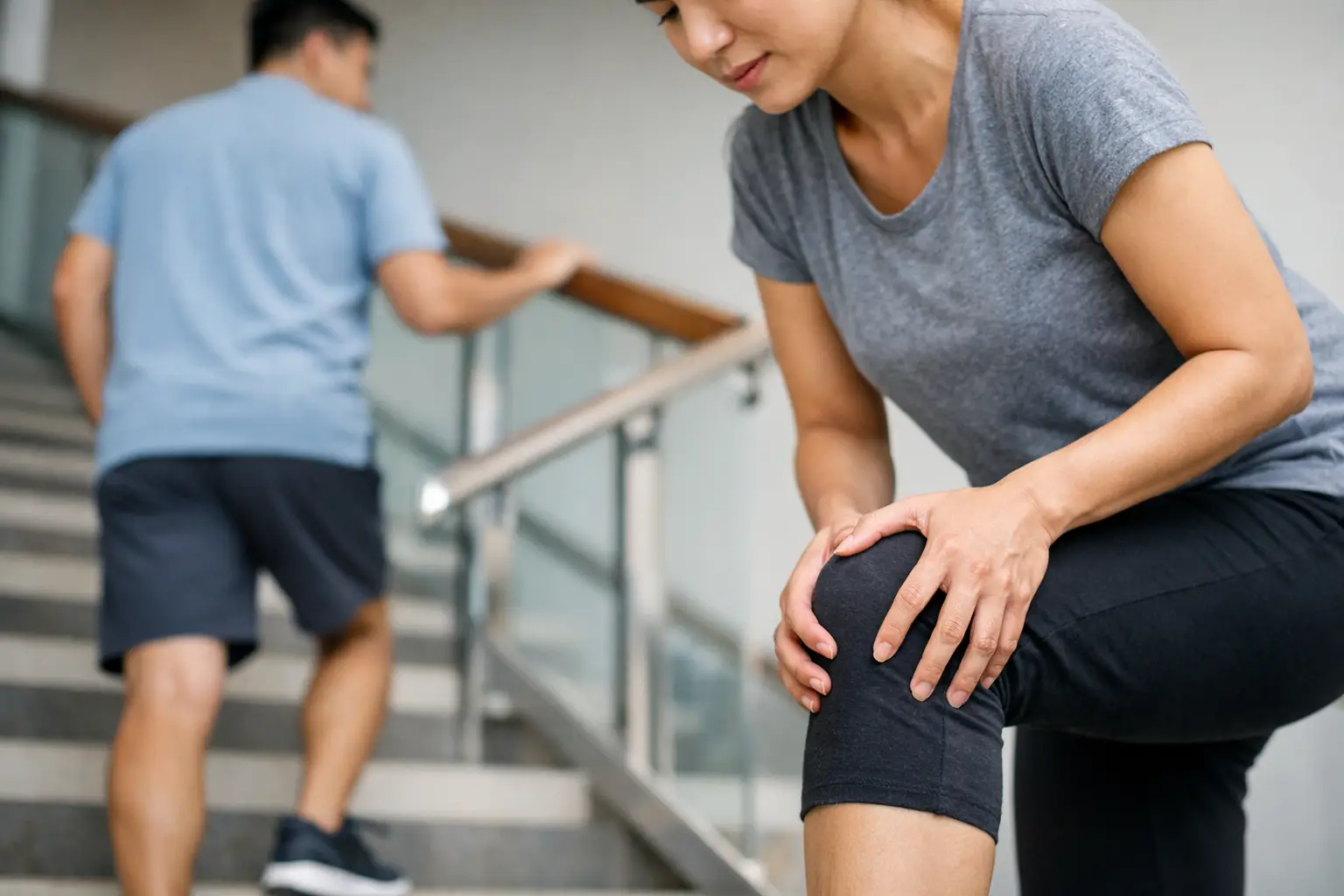
That sharp catch in the knee halfway up the stairs is easy to dismiss the first few times. Then it starts shaping your day – you take the elevator more often, hold the railing tighter, or avoid carrying groceries upstairs because knee pain climbing stairs has become one of the clearest signs that something in the joint is not working the way it should.
Stairs ask more from the knee than flat walking. The joint has to bend deeper, absorb more force, and keep the kneecap tracking smoothly while the muscles around it stay strong and coordinated. When any part of that system is irritated, weak, inflamed, or worn down, stairs tend to expose it quickly.
Why knee pain climbing stairs happens so often
Many people are surprised that they can walk on level ground with only mild discomfort, yet feel real pain on steps. That difference usually comes down to load. Climbing stairs increases pressure through the kneecap and the cartilage behind it. Going down stairs can feel even worse for some people because the knee has to control body weight while bending under tension.
This does not always mean severe joint damage. In some cases, it is a temporary flare from overuse, weak supporting muscles, or irritated soft tissue. In others, it can be an early clue that the joint is dealing with ongoing inflammation, cartilage wear, or alignment problems that need more than rest alone.
Common causes of knee pain climbing stairs
One of the most frequent causes is patellofemoral pain, sometimes described as pain around or behind the kneecap. This often shows up when the kneecap does not move as smoothly as it should in its groove. Weak hips, tight quadriceps, poor movement mechanics, or repetitive strain can all contribute. People often feel aching, pressure, or a grinding sensation when using stairs, squatting, or standing up from a chair.
Osteoarthritis is another major cause, especially in middle-aged and older adults. As cartilage becomes thinner and the joint grows more inflamed, stairs can become noticeably harder. Morning stiffness, swelling, and pain that worsens after activity are common clues. This pattern is especially familiar for people who also notice reduced flexibility or a knee that feels unreliable.
Tendon irritation can also play a role. The patellar tendon, which connects the kneecap to the shinbone, may become sore from repeated strain, especially in active adults or those returning to exercise too quickly. Pain tends to sit below the kneecap and may feel sharper when climbing, lunging, or rising from a seated position.
Meniscus irritation or minor cartilage injury can create pain with twisting, bending, and loaded movement. If the knee clicks, catches, swells, or feels blocked during stairs, that can point to internal irritation rather than simple muscle fatigue.
There is also the issue of inflammation without a dramatic injury. If the tissues around the joint are persistently irritated, even normal daily tasks can begin to hurt. For many people, stairs are simply the first activity that reveals the problem.
What the pain pattern can tell you
Where you feel pain matters. Pain at the front of the knee often points toward kneecap tracking issues, tendon strain, or early arthritic change. Pain on the inside or outside of the knee may suggest meniscus irritation, ligament strain, or uneven loading. Pain behind the knee can sometimes relate to swelling, stiffness, or less common joint issues.
Timing matters too. If the pain is worst when first moving but eases a little as you warm up, stiffness and early arthritis may be part of the picture. If it builds during activity and lingers afterward, overuse or inflammation may be more likely. If the knee swells, locks, gives way, or feels hot, that deserves more careful attention.
The key point is that knee pain is not one condition. Two people can have pain on stairs for very different reasons, which is why a thoughtful, individualized approach usually works better than guessing.
When simple rest is not enough
If your knee pain climbing stairs has lasted more than a couple of weeks, keeps coming back, or is starting to limit your independence, it is worth taking seriously. Pain that changes how you move can create a chain reaction. You may shift weight to the other leg, reduce activity, lose strength, and make the joint even less supported over time.
This is where many people get stuck. They try to push through it on good days and then rely on painkillers on bad days. That can help short term, but it does not always address the underlying inflammation, tissue stress, or gradual decline in joint support.
For people dealing with recurring stiffness, age-related wear, exercise-related discomfort, or inflammatory flare-ups, the better goal is usually not just temporary masking. It is reducing irritation while supporting the joint more consistently.
What can help relieve stair-related knee pain
Start with activity adjustment, not complete inactivity. If stairs are flaring the knee badly, reduce unnecessary trips for a few days and use the railing for support. That gives irritated tissue a chance to settle without letting the joint become even stiffer from too little movement.
Ice can help after a flare, particularly if there is swelling. Heat may feel better before activity if the main problem is stiffness. Neither is a cure, but each can make movement easier when used at the right time.
Targeted strengthening is often one of the most useful long-term strategies. The knee depends heavily on support from the quadriceps, glutes, hips, and calves. When these muscles are weak or poorly coordinated, more strain lands directly on the joint. Gentle strengthening and mobility work can improve how the knee tracks and loads during daily movement. That said, the right plan depends on the cause. Aggressive exercise during an active flare can backfire.
Weight management can also make a meaningful difference for some people. Even modest changes in body weight can reduce repeated stress on the knee during stairs and standing. This is not about perfection. It is about giving an already irritated joint less work to do.
Footwear matters more than many people realize. Worn-out shoes, poor support, or unstable soles can change how force travels through the leg. Some people notice improvement simply from using supportive shoes consistently instead of alternating between helpful and unhelpful options.
Where natural joint support fits in
If your pain is tied to inflammation, stiffness, or chronic wear rather than a single acute injury, joint support supplements may be worth considering as part of a broader plan. This is especially relevant for adults who want relief and improved mobility without depending only on frequent NSAID use.
The quality of the formula matters. A crowded marketplace makes bold promises, but not every product is designed with meaningful doses, complementary ingredients, or long-term joint support in mind. For knee discomfort that shows up on stairs, a carefully screened formula with clinically oriented anti-inflammatory and mobility-support ingredients is more likely to be useful than a generic blend built around marketing claims.
This is one reason some customers prefer a curated specialist rather than a mass supplement store. TSC Health focuses on selective formulas for people dealing with inflammation, stiffness, exercise-related joint discomfort, and day-to-day mobility decline. That kind of quality control matters when the goal is not just buying a bottle, but choosing support you can trust.
Supplements are not instant pain relievers, and they are not a replacement for medical evaluation when symptoms are severe. But for the right person, they can be a practical part of a long-term strategy to calm inflammation, support function, and make movement feel more manageable over time.
When to get the knee checked
You should seek medical evaluation sooner if the knee is visibly swollen, red, unstable, locked, or painful after a fall or twist. The same applies if you cannot bear weight, the pain wakes you at night consistently, or the symptoms keep progressing.
Even without an injury, persistent stair pain deserves attention if it is interfering with work, caregiving, exercise, or basic confidence in movement. Getting clarity early can help you avoid months of compensating and aggravating the joint further.
A better way to think about the problem
Stair pain is not just an inconvenience. It is a useful signal. Your knee is telling you that load, inflammation, joint mechanics, or tissue resilience need attention. The good news is that many cases improve when people stop ignoring the pattern and start supporting the joint more intentionally.
If stairs have become the moment you brace yourself, slow down, or wince, do not treat that as something you simply have to live with. The right combination of movement support, inflammation control, and quality joint care can make ordinary steps feel ordinary again.


